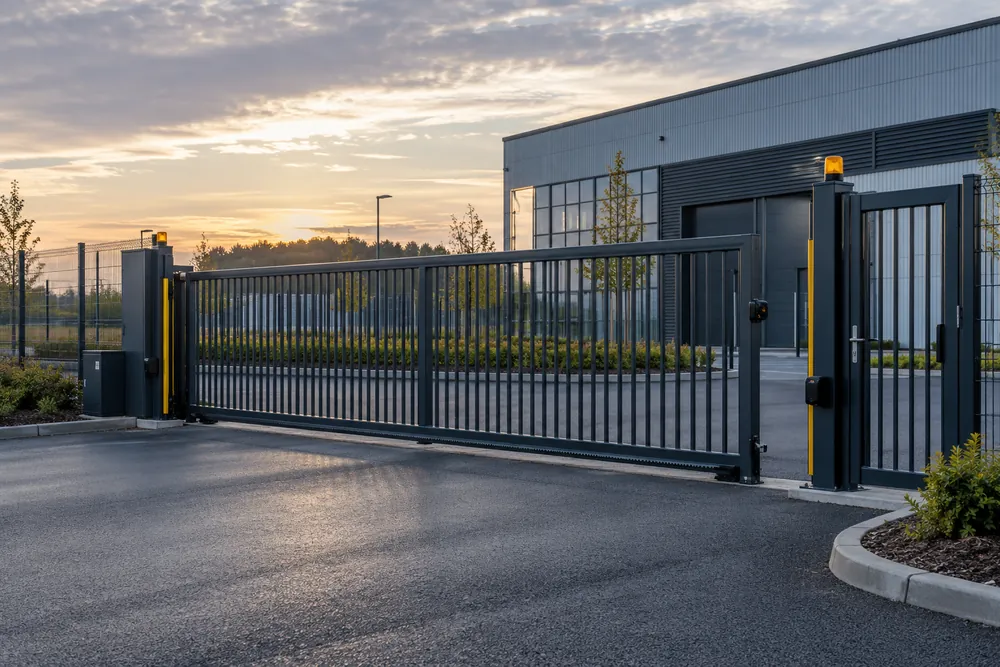
A Gate Is Part Of A Working Site
A commercial gate needs to fit how vehicles arrive, queue and leave. Long delivery vehicles may need space to wait without blocking a road. Staff arriving on foot need a route that does not place them in the movement of a powered gate.
The survey should consider the entire entrance, including visibility, road levels, drainage, fencing and adjacent parking. A suitable gate leaf or motor cannot resolve a layout that brings pedestrians into a trapping area. Raise these issues before choosing between sliding and swinging arrangements.
Sliding Gates, Swing Gates And Barriers
A sliding gate needs suitable run-back space and a layout that protects people from the moving leaf. A swing gate needs a safe opening arc and consideration of wind and ground conditions. A traffic barrier controls vehicles but does not provide the same physical boundary as a gate.
Each option has different civil works, power and maintenance needs. Existing posts or foundations should not be assumed suitable for automation. A competent assessment should consider structural condition and the risks created by the completed assembly, including any fencing or surfaces alongside it.
Powered Gate Safety Responsibilities
HSE guidance explains that powered gates can cause serious injury through crushing, trapping and other hazards. For a powered entrance at a Doncaster commercial property, assess safety when designing the gates, fitting them, commissioning the installation and maintaining it in service. A photocell or force limitation feature on its own is not proof that the whole entrance is safe.
The Supply of Machinery (Safety) Regulations 2008 are relevant to machinery placed on the market or put into service in Great Britain. HSE also identifies duties under workplace legislation, including the Provision and Use of Work Equipment Regulations 1998, where gates are work equipment.
The installer should identify the requirements applying to the particular gate and provide appropriate documentation. Ask for the risk assessment, relevant test results, operating instructions and declaration where required. Standards can help with the design, but do not replace an assessment of the actual hazards.
Access Control And Emergency Arrangements
Gate controls can include staff credentials, intercom calls and authorised vehicle access arrangements. Think about who can open the entrance, when permissions expire and how deliveries are admitted outside staffed hours. An uncontrolled remote release can undermine an otherwise well planned boundary.
Agree what happens on power failure and how authorised people can use the manual release safely. Emergency access arrangements should be discussed with the premises team and relevant advisers. Pedestrian escape needs its own consideration and should not rely on a vehicle access routine that may be unavailable.
If CCTV is used to view the entrance, confirm what the person operating the gate can actually see. A distant camera or delayed image may not show a hazard close to the moving leaf. Video is not a substitute for appropriate gate safety measures.
The Survey And Installation Process
Begin with a site layout and an explanation of vehicle types, delivery patterns and pedestrian routes. Photographs can help identify the entrance, but they do not replace a survey. Note any public access, gradients, exposed locations and restrictions on excavation.
Agree a proposal covering the gate arrangement, civil works, electrical supply, control system and safety measures. Identify responsibility for planning checks, ground services and work by other trades. A retrofit should also explain which existing components can be retained and what needs replacement.
Commissioning should demonstrate normal operation, protective devices, emergency procedures and the behaviour after a fault. Handover needs clear instructions for nominated staff and an agreed inspection and maintenance plan. Keep the records with the facilities documentation so future work starts with the original design information.
Costs, Repairs And Maintenance
Gate dimensions, duty cycle, ground works, foundations, cable routes and access controls all influence cost. Repairs may involve more than changing a motor if the structure or safety arrangement is unsuitable. Ask for a survey based scope rather than a price chosen from a gate photograph.
Plan for inspection, cleaning and maintenance appropriate to the gate and its use. Report unusual noise, damaged safety edges, movement problems or impact damage promptly. If a gate appears unsafe, keep people clear and arrange competent attention rather than repeatedly resetting it to restore access.
Useful Technical Guidance
For the guidance behind these considerations, see HSE Powered Gate Safety, HSE Legal Responsibilities. The applicable requirements should be confirmed for your specific premises.
Automatic Gates: Your Questions
Can Existing Commercial Gates Be Automated?
Existing commercial gates may be suitable for automation after a competent assessment of their structure, layout and hazards. Hinges, posts, foundations, run-back space and pedestrian routes all matter. Retrofitting a motor can introduce new risks, so the proposed assembly needs a safety assessment and appropriate commissioning before it is used.
Do Automatic Gates Need Maintenance?
Automatic gates need planned maintenance and checks suited to their design, condition and use. Safety devices and protective features must remain effective as well as the motor. Keep records, follow the supplied instructions and have defects assessed promptly, especially after an impact, a layout change or repeated operating faults.